AI is a Power Source More Than A Technology - The Cognitive Revolution
AI is a Power Source More Than a Technology
Why thinking of AI as "just another tool" misses the transformation happening right now
When business owners ask me about AI adoption, they often frame it as a technology decision: "Should we add AI to our customer service?" or "Can AI automate our invoicing?" These are good questions, but they're built on a fundamental misunderstanding that holds businesses back.
AI isn't a technology you add to your existing processes. It's a power source that enables entirely new ways of working.
Let me explain what I mean and why this distinction matters for your business.
The Electricity Parallel: A Historical Lesson for Today
In 1882, Thomas Edison's Pearl Street Station began delivering electricity to lower Manhattan. Factory owners immediately saw the potential. They ripped out their steam engines and installed electric motors... in exactly the same configuration.
Early factories had been designed around a single massive steam engine that powered everything through an elaborate system of belts and shafts running along the ceiling. When electricity arrived, factory owners simply replaced the steam engine with an electric motor—keeping all those belts and shafts in place.
Production barely improved.
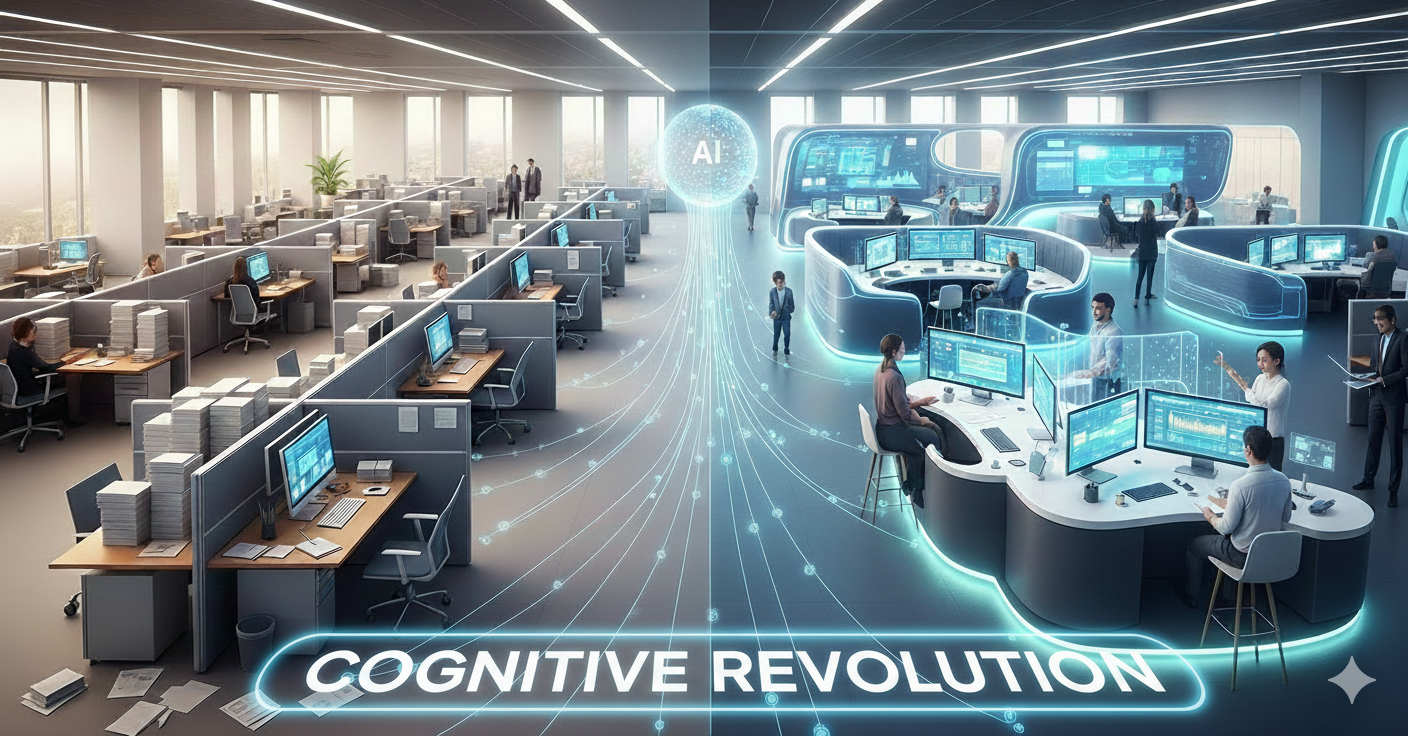
It took nearly 30 years before manufacturers realized their mistake. Electricity wasn't just a replacement for steam power. It was a fundamentally different power source that enabled a completely new factory design. Instead of one central motor, you could put small electric motors on each machine. Workers could space equipment based on workflow logic rather than belt-reach. Production lines became possible. Efficiency multiplied.
The problem wasn't the technology. The problem was that old processes weren't designed with the new power source in mind.
We're making the same mistake with AI right now.
Why Your Current Processes Weren't Built for AI
Most business processes were designed in an era when human cognitive labor was the only option. We built workflows around what people could reasonably do, given the limitations of time, attention, and memory.
Here's what that looked like in practice:
Manual Data Entry as a Bottleneck
A logistics company manually enters shipment information into three different systems because that's how the software was purchased over the years. The process assumes someone will be typing, so there's no consideration for real-time data synchronization or automated handoffs. When you try to "add AI" to this process, you're just asking AI to do the typing, missing the opportunity to eliminate the need for separate systems entirely.
Sequential Review Processes
An accounting firm routes client documents through a chain of reviewers: junior staff summarizes, senior staff reviews the summary, partners make decisions. This sequential flow exists because one person can't instantly process 500 pages of financial data. But AI can analyze that entire document set in seconds and present structured insights. The question isn't "Can AI help with the summary?" it's "Why are we summarizing at all when we can query the source directly?"
Batched Communication
Property management companies check tenant maintenance requests once or twice daily because constant monitoring would be impossible for human staff. The process accepts delays as inevitable. But with AI monitoring, response can be immediate, categorization can be intelligent, and urgent issues can be escalated instantly. The batching was never a feature, it was a limitation we designed around.
Rigid Templates and Forms
Construction firms use standardized proposal templates because creating custom quotes for each client would take too long. The template approach trades personalization for speed. AI changes this equation entirely as it can generate fully customized proposals at template speed, pulling from your historical data, current pricing, and specific client context.
These weren't bad processes when they were designed. They were brilliant solutions to human limitations. But now those limitations are gone.
The Mental Shift: From Automation to Augmentation to Transformation
When electricity arrived, factory owners had to learn to think differently about physical work. When AI arrives, we have to learn to think differently about cognitive work.
This progression happens in three stages:
Stage 1: Automation (Starting Point - Efficiency)
This is where most businesses start and often get stuck. "Let's use AI to fill out these forms faster" or "Can AI schedule these meetings automatically?" You're asking AI to replicate human actions within existing workflows. You will most likely see 10-20% efficiency gains, but you're essentially installing electric motors on your belt-driven factory layout.
Stage 2: Augmentation (Adding Capacity)
Here, you're giving humans new capabilities they didn't have before. A sales team uses AI to analyze customer sentiment across all communications. A warehouse manager gets predictive maintenance alerts before equipment fails. An accountant queries their entire client history in natural language. These are more significant improvements where you realize maybe 2-3x productivity gains because you're adding new capacity, not just speeding up old tasks.
Stage 3: Transformation (The Real Opportunity)
This is where you redesign processes from scratch, assuming AI capabilities exist. You ask: "If I could instantly analyze any amount of information, respond in real-time, and never forget context, what would my customer service look like?" Or: "If I could generate custom proposals at scale, how would I approach new business?"
This is the stage where companies see 10x improvements and not because AI is particularly magical, but because they've finally stopped trying to preserve old processes designed around old limitations.
What This Means for Your Business Today
If you're approaching AI adoption as "What AI tools should we add to our current processes?", you're asking the wrong question.
The better questions are:
- What processes exist only because of human limitations that no longer apply? Your sequential approval chains, your batched responses, your standardized templates—these were workarounds. What would you do if those limitations disappeared?
- What business capabilities are now possible that weren't before? Real-time analysis of customer interactions across all channels. Instant, customized responses to complex inquiries. Predictive insights from years of historical data. These aren't better versions of old tasks, they're entirely new capabilities.
- Where are we still organizing work around typing, when we could be organizing around thinking? If someone in your organization spends their day moving information between systems, summarizing documents, or reformatting data that's a signal that your processes are still designed for the steam-power era.
The Practical Path Forward
This doesn't mean you need to tear down everything and rebuild from scratch tomorrow. The electricity transformation took 30 years. Your AI transformation will be iterative too.
But it does mean you need to start thinking differently now. Here's how we guide businesses through this:
1. Map Your Cognitive Bottlenecks
Where do information handoffs slow you down? Where do people spend time translating or reformatting data? Where do delays happen because someone needs to review, summarize, or analyze something? These are your opportunities, but only if you're willing to redesign the process, not just automate the current steps.
2. Question Your Constraints
For each major process, ask: "What would this look like if we had infinite capacity to read, write, analyze, and respond?" Many of your "that's just how it works" assumptions are actually artifacts of pre-AI limitations. Challenge them.
3. Start with Capability, Not Tools
Instead of "We need a chatbot," think "We need the ability to respond instantly to customer inquiries with full context from our entire history." The first leads to bolting AI onto your existing phone system. The second leads to redesigning how customer communication works. Same technology, completely different outcome.
4. Embrace the Learning Curve
When factories electrified, workers had to learn new skills. Machine operators needed different expertise. Workflow patterns changed. The same is true now. Your team will need to learn to work with AI capabilities, not just use AI tools. That means thinking differently about problem-solving, decision-making, and process design.
5. Accept That "Best Practices" Are Obsolete
Most industry best practices were developed in the pre-AI era. They optimized for human constraints that no longer exist. Following them now is like factory owners in 1920 consulting 1890s efficiency manuals. Learn from your industry's past, but don't be bound by processes that were designed for different limitations.
The Human Element Remains Central
Here's the crucial point that gets lost when people debate AI: this isn't about replacing human intelligence. It's about freeing human intelligence from mechanical cognitive work.
Electricity didn't eliminate factory workers—it eliminated the need for workers to manually turn cranks and pull levers. Workers could focus on skilled tasks, quality control, and process improvement instead of brute physical labor.
AI does the same for cognitive work. Your team shouldn't spend their days copying data between systems, summarizing documents they've already read, or doing mental math on information they've already analyzed. Those tasks made sense when there was no alternative. Now there is.
The businesses that thrive in this transition won't be the ones that deploy the most AI tools. They'll be the ones that successfully redesign their work around AI as a power source—freeing their people to do what only humans can do: understand context, make judgment calls, build relationships, and solve novel problems.
Your Next Step
If you're reading this and thinking "This makes sense, but I don't know where to start," you're not alone. Most business leaders know their current processes aren't optimal, but they're so embedded in day-to-day operations that redesigning them feels impossible.
That's exactly why we built our AI Readiness Assessment. It's not about showing you which AI tools to buy. It's about identifying where your processes are still designed for steam power—and mapping the path to rebuild them for the AI era.
We look at your workflows through a simple lens: "If these processes were designed today, with AI capabilities available, what would they look like?" The gap between current state and that answer tells us exactly where to focus.
The companies that act now—while their competitors are still trying to bolt AI onto old processes—will build advantages that are extremely hard to catch. Not because AI is magic, but because they're building processes their competitors can't even imagine yet.
Just like those early factory owners who redesigned their production lines around electricity, you have a window to fundamentally rethink how work gets done in your business. The question is: will you use AI to make your steam engine a bit faster, or will you design the factory of the future?
>Ready to Rethink Your Processes? Schedule your Foundation Assessment and discover where rethinking your processes can lead to major profits.
Brian Pellnitz, Founder
Gainwise Partners | AI Adoption for SMBs
20+ Years of Enterprise Technology Leadership