Finding and Fixing Bottlenecks: How the Theory of Constraints and AI Work Together
Finding and Fixing Business Bottlenecks: How the Theory of Constraints and AI Work Together
Every successful business eventually hits the same wall: growth slows, margins compress, and what used to work suddenly doesn't scale anymore. You hire more people, but output doesn't increase proportionally. You invest in new equipment, but delivery times barely improve. Sound familiar?
After two decades of leading enterprise technology transformations, I've seen this pattern countless times. The problem isn't effort—it's focus. Most businesses try to improve everything at once, spreading resources thin and seeing minimal results. The solution lies in a proven framework combined with modern tools: the Theory of Constraints (TOC) enhanced by artificial intelligence.
What Is the Theory of Constraints?
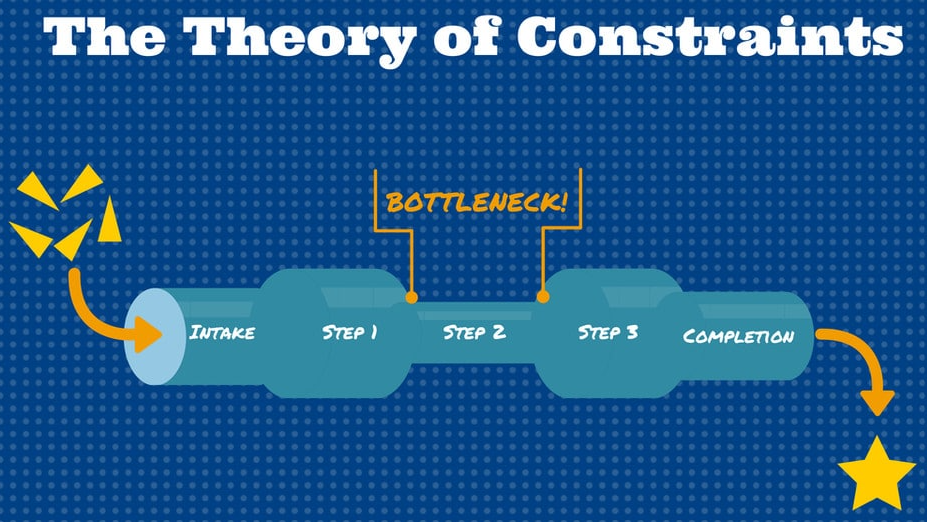
Developed by Dr. Eliyahu Goldratt in the 1980s, the Theory of Constraints recognizes a simple truth: every system has exactly one constraint that limits its performance at any given time. Like a chain's weakest link, this constraint determines your maximum throughput, regardless of how efficient everything else becomes.
Think about your business right now. If you could wave a magic wand and instantly improve any single process, which one would create the biggest impact on revenue, customer satisfaction, or operational efficiency? That's probably your constraint.
Traditional TOC required extensive manual data collection, observation, and analysis. Business consultants would spend weeks shadowing operations, interviewing employees, and analyzing spreadsheets. This worked, but it was slow, expensive, and often outdated by the time recommendations were implemented.
Enter artificial intelligence.
AI doesn't replace TOC—it supercharges it. By automating data collection, identifying patterns human analysts might miss, and continuously monitoring operations, AI transforms TOC from a periodic consulting engagement into an ongoing operational advantage.
The Five Principles of the Theory of Constraints
Let's break down the five focusing steps of TOC and examine how AI amplifies each one for modern SMBs.
1. Identify the Constraint
Traditional TOC Approach:
Manually observe operations, interview staff, analyze historical data, and create process flow diagrams. This could take weeks or months and relied heavily on human observation and intuition.
AI-Enhanced Approach:
AI analyzes operational data in real-time, identifying bottlenecks through pattern recognition that would be impossible manually. Modern workflow automation tools can track cycle times, queue lengths, and resource utilization across your entire operation.
Real-World SMB Example:
A Tampa-area logistics company suspected their dispatch process was the constraint limiting daily deliveries. Using AI-powered analysis of their existing systems (CRM, GPS tracking, and scheduling software), we discovered the real constraint: the manual quote generation process. Sales reps spent 45 minutes per complex quote, creating a 3-day backlog during busy periods. Fixing dispatch wouldn't have moved the needle—we needed to address quoting first.
AI tools that help:
- Process mining software analyzes event logs from your existing systems
- Machine learning algorithms identify patterns in workflow data
- Natural language processing extracts insights from employee communications
- Computer vision analyzes physical operations for bottlenecks
2. Exploit the Constraint
Traditional TOC Approach:
Once identified, you maximize the constraint's effectiveness with existing resources. This means eliminating downtime, reducing changeovers, and ensuring the constraint always has work available.
AI-Enhanced Approach:
AI continuously optimizes constraint utilization in real-time, making adjustments faster than any human could. It predicts when the constraint will be idle and proactively feeds it work, maximizing throughput without additional investment.
Real-World SMB Example:
For that logistics company, we implemented an AI-assisted quoting system using n8n workflows and Claude AI. The system:
- Automatically extracted requirements from customer emails
- Generated accurate quotes using historical pricing data and current costs
- Reduced quote generation time from 45 minutes to 5 minutes
- Freed sales reps to focus on complex negotiations and relationship building
Result: Quote backlog eliminated within two weeks, sales capacity increased by 400%, and quote accuracy improved by 23%.
AI tools that help:
- Predictive analytics forecast constraint demand
- Automated scheduling optimizes constraint utilization
- AI assistants handle routine tasks that feed the constraint
- Real-time dashboards monitor constraint performance
3. Subordinate Everything Else to the Constraint
Traditional TOC Approach:
Align all other processes to support the constraint's optimal performance. Non-constraint resources intentionally operate below maximum capacity to avoid creating inventory or waste that the constraint can't process.
AI-Enhanced Approach:
AI orchestrates upstream and downstream processes to maintain perfect flow to the constraint. It automatically adjusts non-constraint processes based on real-time constraint status, preventing both starvation and overflow.
Real-World SMB Example:
A professional services firm discovered their constraint was partner review time—proposals sat waiting for partner approval for 5-7 days. We subordinated earlier processes by implementing:
- AI-powered proposal drafting (reducing initial draft time by 60%)
- Automated completeness checking before partner review
- Prioritization algorithms that surfaced high-value proposals first
- Automated follow-up for missing client information
This didn't speed up partner review directly, but it ensured every proposal reaching partners was complete, accurate, and properly prioritized—maximizing the value of limited partner time.
AI tools that help:
- Workflow automation platforms (n8n, Zapier) coordinate processes
- AI agents manage work-in-progress inventory
- Intelligent routing systems prioritize constraint input
- Automated quality checks prevent defects from reaching the constraint
4. Elevate the Constraint
Traditional TOC Approach:
If exploiting and subordinating aren't enough, invest in expanding the constraint's capacity. This might mean hiring more staff, purchasing equipment, or outsourcing specific functions.
AI-Enhanced Approach:
AI helps you make smarter elevation decisions by modeling the impact of different investments before you commit resources. It can also augment human constraints through automation, effectively increasing capacity without proportional cost increases.
Real-World SMB Example:
A Central Florida warehouse faced a constraint in order picking—their best pickers could handle 120 orders per day, but demand was growing to 150+ orders daily per picker. Before investing in additional warehouse staff ($45K+ annually per picker), we implemented AI-enhanced solutions:
- Computer vision system validated picks in real-time (reducing error-related rework by 35%)
- AI-optimized pick routes (reducing walking time by 28%)
- Predictive staffing based on order forecasts (eliminating overtime during peaks)
Result: Existing pickers now handled 165+ orders per day. The constraint shifted to packing stations, but we'd increased capacity by 37% without adding headcount.
AI tools that help:
- Digital twins simulate capacity changes before investment
- AI augmentation multiplies human capability
- Predictive analytics inform capacity planning decisions
- Automation handles constraint-adjacent tasks
5. Return to Step One (Continuous Improvement)
Traditional TOC Approach:
Once you elevate a constraint, it moves elsewhere in the system. The process repeats continuously—identify, exploit, subordinate, elevate, repeat. This creates ongoing improvement but requires constant vigilance and analysis.
AI-Enhanced Approach:
AI continuously monitors all processes, automatically identifying when the constraint shifts and alerting you to new opportunities. What used to be a quarterly or annual consulting project becomes real-time operational intelligence.
Real-World SMB Example:
After fixing the quoting bottleneck for our logistics client, AI monitoring revealed the new constraint: route optimization. Dispatchers were manually planning routes each morning, which limited daily deliveries. We implemented AI-powered route optimization that:
- Analyzed traffic patterns, delivery windows, and vehicle capacity
- Generated optimal routes in minutes instead of hours
- Adjusted routes dynamically based on real-time conditions
- Increased deliveries per truck by 18% without adding vehicles
The continuous monitoring meant we caught this new constraint within weeks instead of months, maintaining momentum on operational improvements.
AI tools that help:
- Real-time operational dashboards
- Automated anomaly detection
- Performance metric tracking across all processes
- Predictive alerts for emerging constraints
Why TOC + AI Is Perfect for SMBs
Large enterprises have always been able to afford dedicated operational excellence teams, expensive consulting engagements, and lengthy improvement initiatives. SMBs haven't had that luxury—until now.
The combination of TOC and AI democratizes operational excellence:
Cost-Effective: AI tools eliminate the need for expensive consultants to manually analyze operations. What used to cost $50,000+ in consulting fees can now be accomplished with smart software implementation and guidance.
Fast Results: Traditional TOC projects took months. AI-enhanced approaches deliver insights in weeks and show measurable improvements within 30-60 days.
Continuous, Not Episodic: Instead of periodic improvement projects, AI provides ongoing optimization. Your business keeps getting better automatically.
Scales With Your Growth: As your business grows and constraints shift, AI adapts. You're not locked into solutions that become obsolete as you expand.
Tool-Agnostic: We recommend AI solutions based on your specific constraints, not vendor relationships. Whether that's n8n for workflow automation, predictive analytics in your existing systems, or AI assistants for knowledge work—the right tool depends on your constraint.
The Hidden Danger: Improving the Wrong Things
Here's the uncomfortable truth: most business improvement efforts focus on non-constraints. They feel productive, they generate activity, but they don't move the needle on what matters.
I see this constantly:
- Warehouses invest in faster picking equipment when shipping delays are the real constraint
- Professional services firms improve proposal quality when partner review capacity is the bottleneck
- Retailers optimize checkout speed when inventory availability is limiting sales
These improvements aren't worthless—they just don't impact throughput. It's like polishing a chain's strong links while ignoring the weak one. You're working hard, spending money, but results remain flat.
AI helps avoid this trap by objectively identifying constraints based on data, not assumptions. It removes organizational politics and personal biases from the equation, focusing improvement efforts where they actually matter.
Getting Started: TOC + AI for Your Business
Every business is different. Your constraint might be:
- Time-based: Partner review capacity, customer service response time, production lead times
- Knowledge-based: Complex quoting, technical problem-solving, strategic decision-making
- Physical: Manufacturing capacity, warehouse space, delivery vehicles
- Market-based: Lead generation, sales conversion, customer acquisition cost
The first step isn't implementing AI—it's identifying your specific constraint. Once you know where the bottleneck lives, AI becomes the tool that helps you exploit, subordinate, and eventually elevate it.
This is exactly why we developed our Foundation Assessment: to help SMBs cut through the AI hype and identify real operational constraints that technology can address.
The Foundation Assessment: Your Clear Starting Point
Based on decades of enterprise technology implementation experience, we've developed a systematic approach to cut through the AI noise and create practical implementation roadmaps.
Our Foundation Assessment delivers:
- Value Chain Analysis: We map your primary and support activities, then identify where AI can amplify your competitive advantage without diluting your strategic focus
- Workflow Analysis (TOC-Based): We map your current manual processes, identify constraints using Theory of Constraints principles, and pinpoint automation opportunities that actually impact throughput
- Strategic Alignment Filter: We ensure AI initiatives support your chosen strategy (cost leadership, differentiation, or focused niche) rather than creating expensive distractions
- ROI Prioritization: We rank potential AI implementations by impact and effort, focusing on constraint-based improvements first
- Tool-Agnostic Recommendations: We suggest solutions based on your needs, not vendor relationships
- Clear Roadmap: You get an actionable plan tailored to your specific business needs and constraints
This isn't about selling you on the latest AI trend. It's about understanding your specific operational challenges, identifying your true constraints, and determining if—and how—AI can address them in practical, measurable ways while strengthening what makes your business unique.
Your Next Step Is Simpler Than You Think
Here's what decades of technology implementation have taught us: the businesses that succeed with new technology don't start with the most advanced tools. They start with the clearest problems.
If you're feeling stuck, overwhelmed, or unsure where AI fits in your business, that's completely normal. Most business owners feel exactly the same way when facing any significant operational change.
The difference between businesses that successfully implement AI and those that don't? Taking the next step.
Ready to cut through the AI noise and get a clear roadmap? Our Foundation Assessment takes the guesswork out of AI implementation. We can discuss your biggest operational challenges and determine if AI can solve them.
Schedule Your Discovery Call →
Or, if you prefer to start with a deeper dive: Learn More About Our Foundation Assessment →
Gainwise Partners specializes in practical AI solutions for SMBs. We're tool-agnostic, ROI-focused, and committed to being your human liaison to inhuman AI. Based in Florida's I-4 corridor, we work with businesses nationwide.
About the Author: Brian Pellnitz brings 20+ years of enterprise technology leadership to small business AI adoption. Before founding Gainwise Partners, he led digital transformation initiatives that delivered measurable ROI across industries from logistics to professional services.